Exif
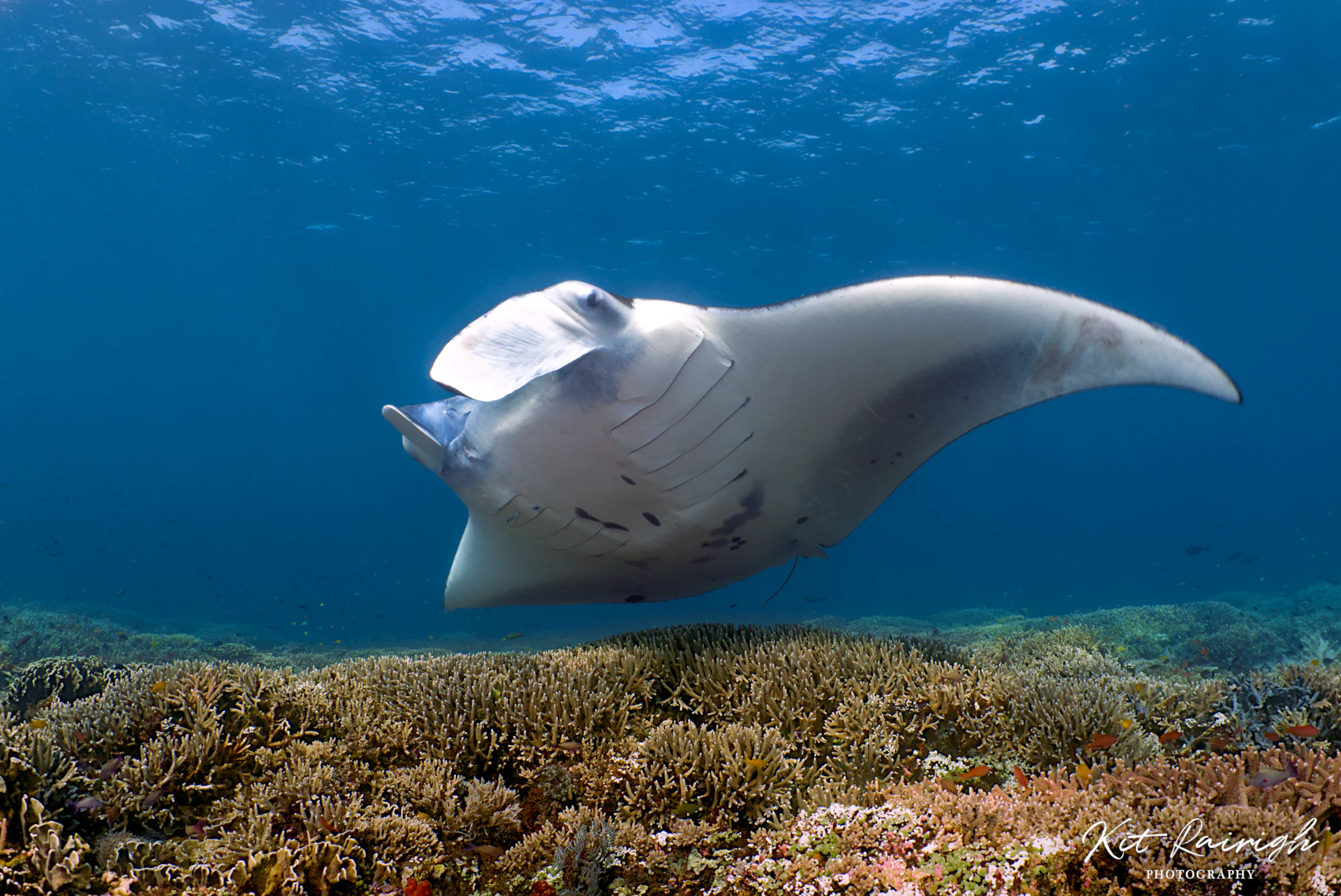
One of my all-time favorite shots during an incredible trip to the Komodo Island in Indonesia was a true test of diving abilities and camera work. This is a photo that, to me, shows a balance of power, beauty, and diversity in a tropical seascape. The raw photo itself came out wonderfully, but did require some relatively “standard” work in post-production to recreate the ambiance I felt in the moment.
The Story
In 2018, my (future) wife and I went on a diving trip that took us through Papua New Guinea, and three separate locations in Indonesia. This was my first time to these countries and I had no idea what to expect. Perhaps I will share stories from the adventure another time.
The last leg of our journey was on a traditional Indonesian phinisi liveaboard. We despise the fancy, extravagant trips often sold to foreigners and prefer to find local ships using local guides, serving local food, and keeping the group sizes small. While not always true, this supports the local economy and reduces our carbon footprint.
About midway through our trip, we were taken at sunrise to a popular “Manta hangout” that would be crowded with day-trip boats later in the day. During the dive, we drifted along with the current following our guide until he finally spotted a manta. But the ray seemed shy and would quickly check out the group before turning the other way. As diving instructors, we are used to keeping our heads on a swivel, and happened to look in the deeper water behind us. There we saw 2 huge mantas feeding and slowly working their way towards us.
My wife and I turned, stayed low to the coral (but giving enough space as not to touch it!), and let the mantas come to us. Slowly but surely, they eventually came up close. I set my camera, turned the flash to a low setting and pointed it up at a 45 degree angle. When this manta swooped overhead, I snapped the shot and enjoyed the next 20 minutes while the two mantas danced around us.
Eventually the rest of the group caught on and the swarm of divers scared off the two mantas. But for those 20 minutes or so “alone” with the creatures was absolutely magical.
The Subject
Mobula alfredi. I am not an expert in identification, but I believe this was indeed a Reef Manta Ray, and not an Mobula birostris (Oceanic Manta Ray). Any expert out there, please correct/confirm in the comments section at the end of the article and I will amend this part of the article!
Manta rays are often confused with their counterparts: stingrays. While mantas do indeed have a tail that looks similar to that of a stingray, it does not have the same “stinging” blades nor venom. Instead, manta rays’ defense mechanisms are its impressive size, speed, and maneuverability.
Mantas are filter feeders, which is why you will often see them with their mouths wide open, doing loops and swoops in the water to gather as much plankton as possible. However, being a filter feeder is also one reason they are particularly vulnerable to ocean microplastics since they will consume and accumulate large quantities.
Another huge pressure on manta ray populations is overfishing - some believe that the ray’s gills hold medicinal properties (unproven by science), and bycatch - rays are often trapped in nets that are not meant for them. Finally, as the climate changes, so does the food availability and habitat for these creatures.
The Environment
In this shot, I was in relatively shallow water (5-8 meters), hovering just above a beautiful and extensive coral reef. Fortunately, the water was relatively clear and the sun was shining brightly, but not directly overhead. This makes for some good photographic conditions.
Firstly, I have talked about it before and I will talk about it again… When scuba diving, our first priority must be to protect the environment. There is no excuse for breaking corals or disturbing wildlife! So before I even begin to talk about anything related to photography, the first step is to have perfect buoyancy. It is a very challenging skill to master, and even after thousands of dives, we can still keep working on it, learning to be better and better.
As a follow-up, I would say another critical skill in these situations is body awareness. It’s not easy when you’re covered in a wetsuit or dry suit, carrying gear, and having long fins sticking off the end of your feet. However, we must always be aware of our surroundings. During this dive, while the manta rays were dancing about us, I was constantly on the lookout for where I was in relation to the reef, to my buddy, other wildlife, and other divers. I probably missed 20-30 photos because of this. That’s OK. More importantly, I did not put the reef, wildlife, or anyone else at risk because of my behavior.
Finally, as you probably well know, coral reefs are under a massive threat from climate change, and are going through unprecedented bleaching events at an every increasing rate (in fact, as I write this, the Great Barrier Reef in Australia is going it’s 5th bleaching in 8 years) and at previously unseen levels. There is hope on the horizon as some scientists are working to restore the reefs by capturing spawning corals and attracting them to damaged areas. But this is still just a hope. To truly have a chance for our coral reefs to survive, our society must transition to more sustainable and environmentally harmonious conduct.
The RAW shot
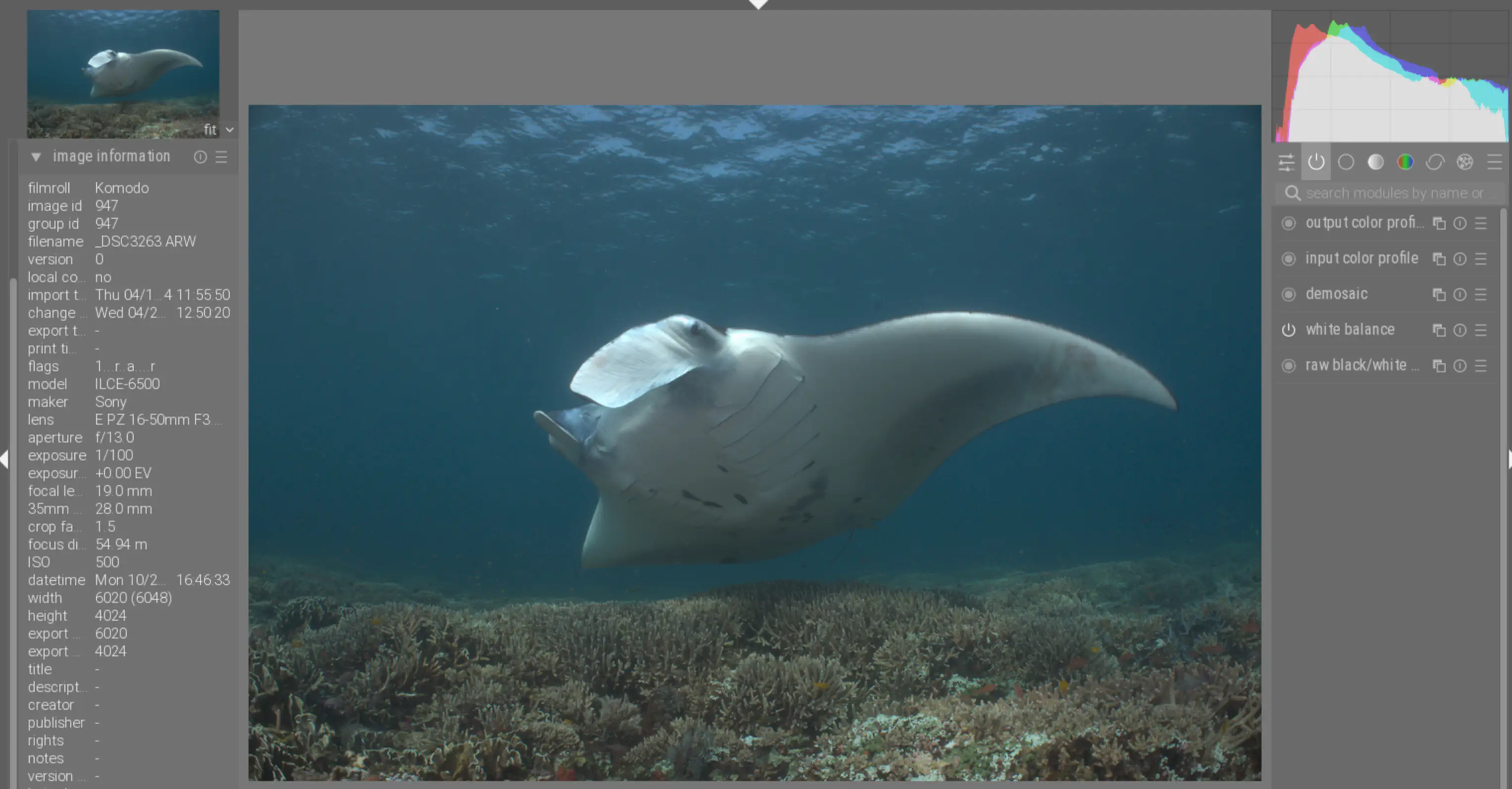
The blueish haze can make one think the photo isn’t great at first look.
The first time I saw manta rays was on a moonless night dive in Hawaii where we held huge flashlights pointed upwards to light the plankton. This attracted mantas from all around. It must have been just my 9th or 10th dive ever, and to experience their dance just centimeters from my head was mind-blowing.
Moving forward to the time of this photo: we had done a dive with mantas a day prior and I got a handful of photos. But to me the photos felt flat and did not really capture the emotion I felt the first time I encountered manta rays. So how did I get this shot? I started by putting my camera to the side. Instead of trying to “capture” a moment with these creatures, I just simply existed in the moment and let the creatures do their dance.
At one moment, one of the mantas traveled directly overhead through the stream of bubbles coming from my exhale. I thought: THIS is the moment I want to relive. So the following day when we were heading to another manta feeding area, I was looking for this opportunity.
To get the shot, I knew I wanted to use as much natural light as possible, while giving just a small fill light to the underside of the manta passing overhead. So my thought process was this:
- Use an ISO that wouldn’t produce too much noise, but would give enough light to capture the distant reef.
- Use a smaller aperture to produce a sharp photo in both the foreground and across the manta.
- Use a fast enough shutter speed to not give any motion blur.
- Set my flash low, while pointing it upwards at a ~60 degree angle to light the underside of the manta without lighting the water between the lens and the manta.
A side note on working with natural light: In many ways it can produce the best underwater shots. But, as on land, we should be aware of the shadows and angle of the light as it enters the water. This can have a huge effect on our shot to either create a flat, lifeless image, or one with depth, color variations, and even some ripples from the surface. Furthermore, with depth comes color loss - water acts as a filter and will reduce your reds VERY quickly. This is where I still use a flash, but on a very low setting just to help bring back some of the natural colors before post-production.
Perhaps the shutter speed was too slow, as the creature did indeed create a slight motion blur. However, I am content with the result as I feel it adds to the feeling of motion. The ocean is always in motion, and so are its inhabitants.
The Edit
In this case I feel like I am starting with a pretty decent raw image: exposure isn’t off by much, colors are decent, and not much backscatter.
But anytime we shoot underwater, one must be aware of how the water filters the colors. Anything at a distance outside the range of my flash will likely have an aqua-blueish tint. For me, this is a common issue, and one of the first edits I make to the raw file before even touching it with my photo editor. Let’s have a look at the image in Darktable (here v 4.6.1) and see what we can do.
Remember that when we are editing the raw file, there is more pixel “data” stored, so we have greater ability to adjust the image without “clipping” into unwanted areas. However, I am not trying to create the perfect final image here. I want to get as close as possible, but will do final fine-tuning in the actual photo editing software.
I always start with a few fundamental filters: lens correction, denoise (profiled to my camera and ISO level), and exposure. This gets me in the right territory before making other adjustments.
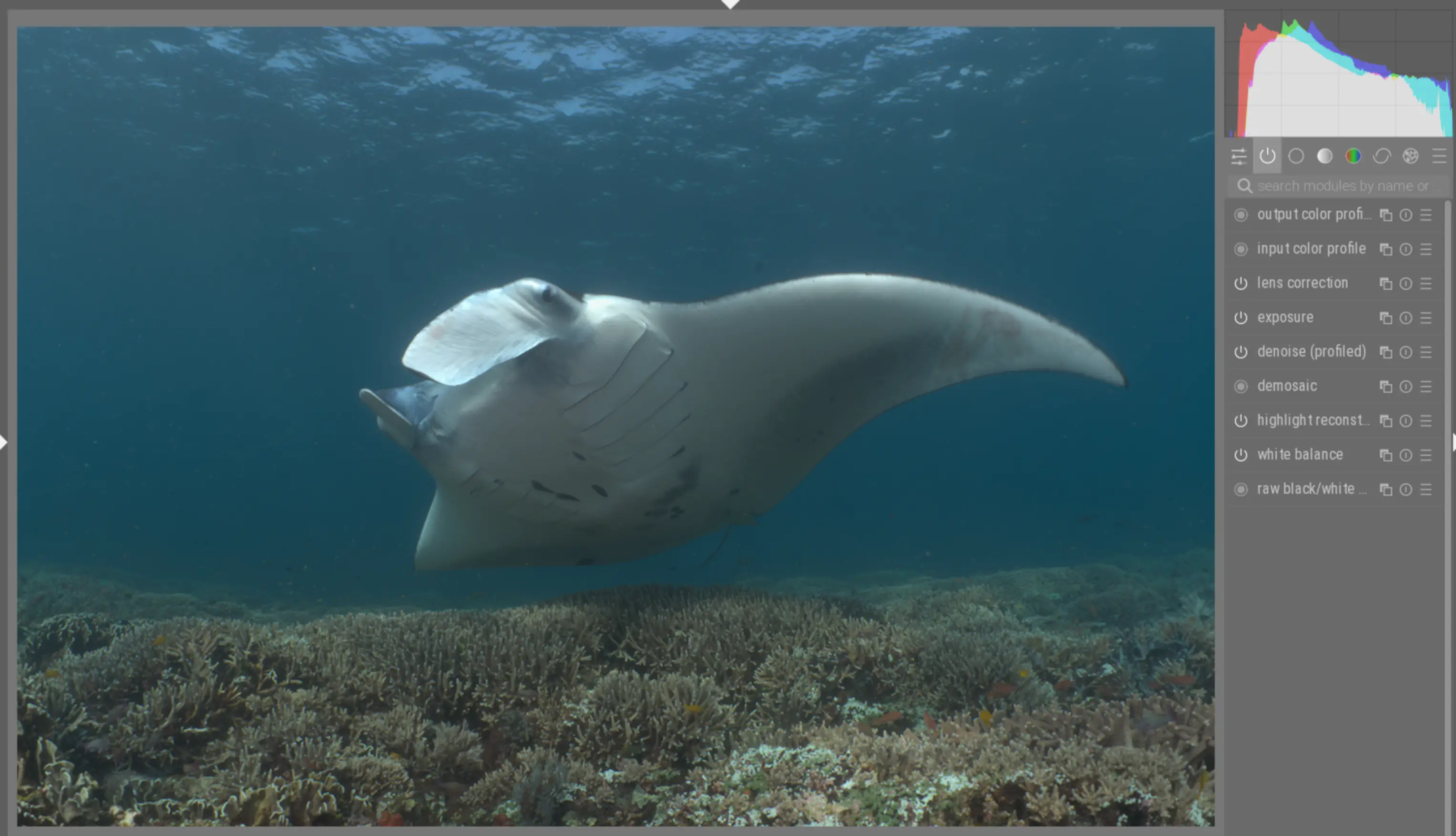
Starting with the correct exposure helps to define what areas should be white or black.
Now to adjust for our filtered light. I primarily rely on two filters: “RGB levels”, and “color zones”. I use the RGB levels filter to do the heavy lifting. You can usually start with the “auto” setting, and then fine tune the handles from there. Here you can see where I’ve adjusted out a lot of the hazy aqua color to get better whites, and more colorful corals and fish.
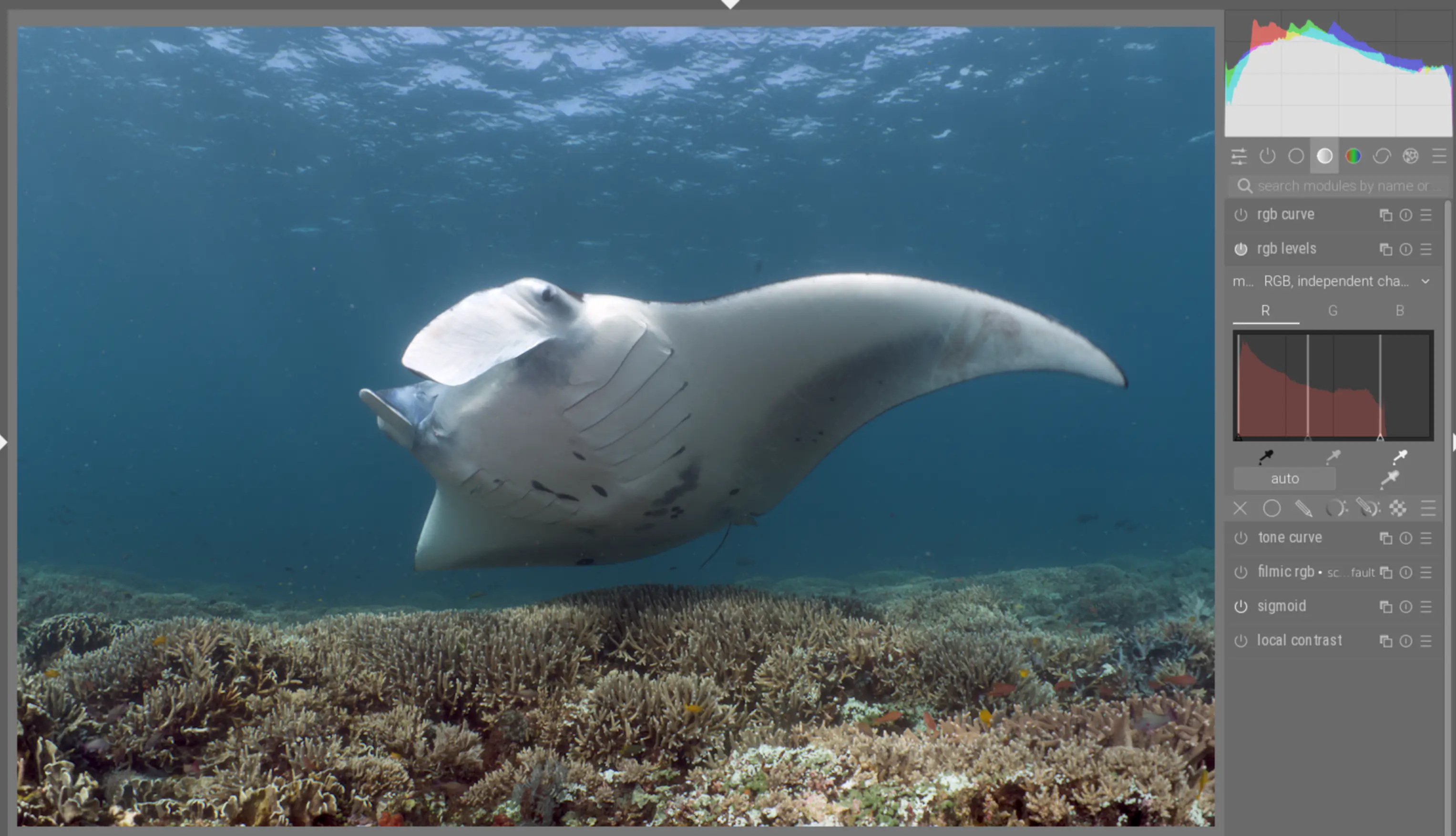
This filter can have a huge effect. Go slowly with each movement of the sliders.
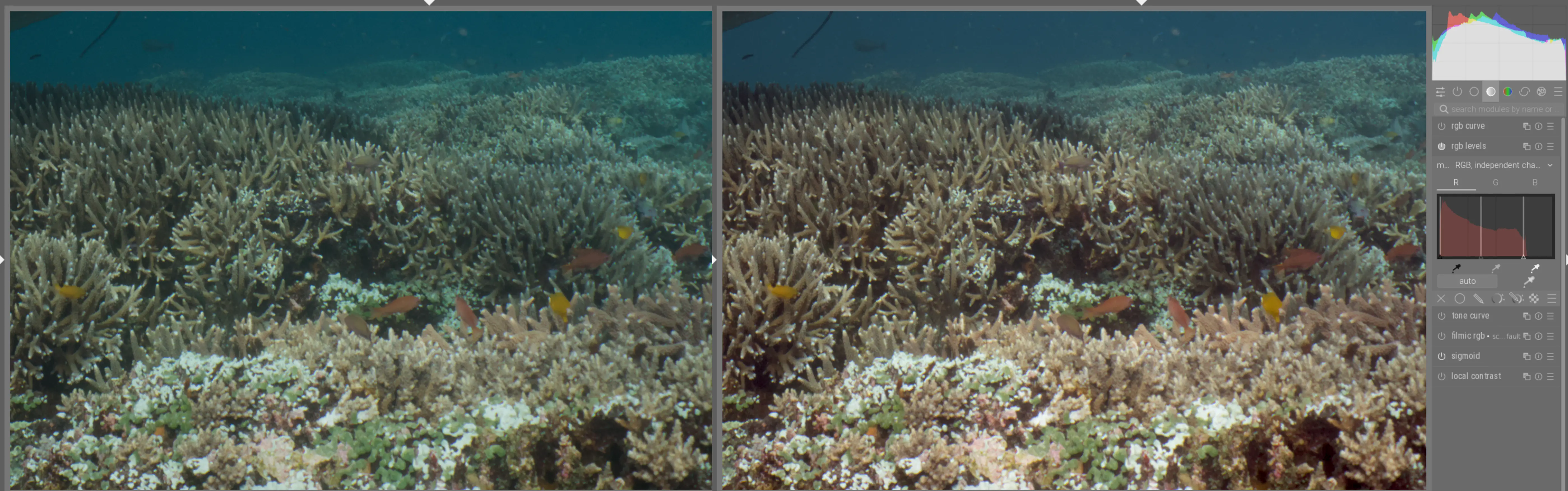
A closer look at the before (left) and after (right).
You may also notice in the histogram (top right corner) the increased dynamics of the photo - now we have actual whites and blacks.
Next, to target the highlights specifically, I will use the color zones filter on the aqua’s (between the greens and blues). Again, I don’t want to completely eliminate them. First, I will click on the eyedropper tool, and select a white/gray area where I want to reduce the aqua’s:
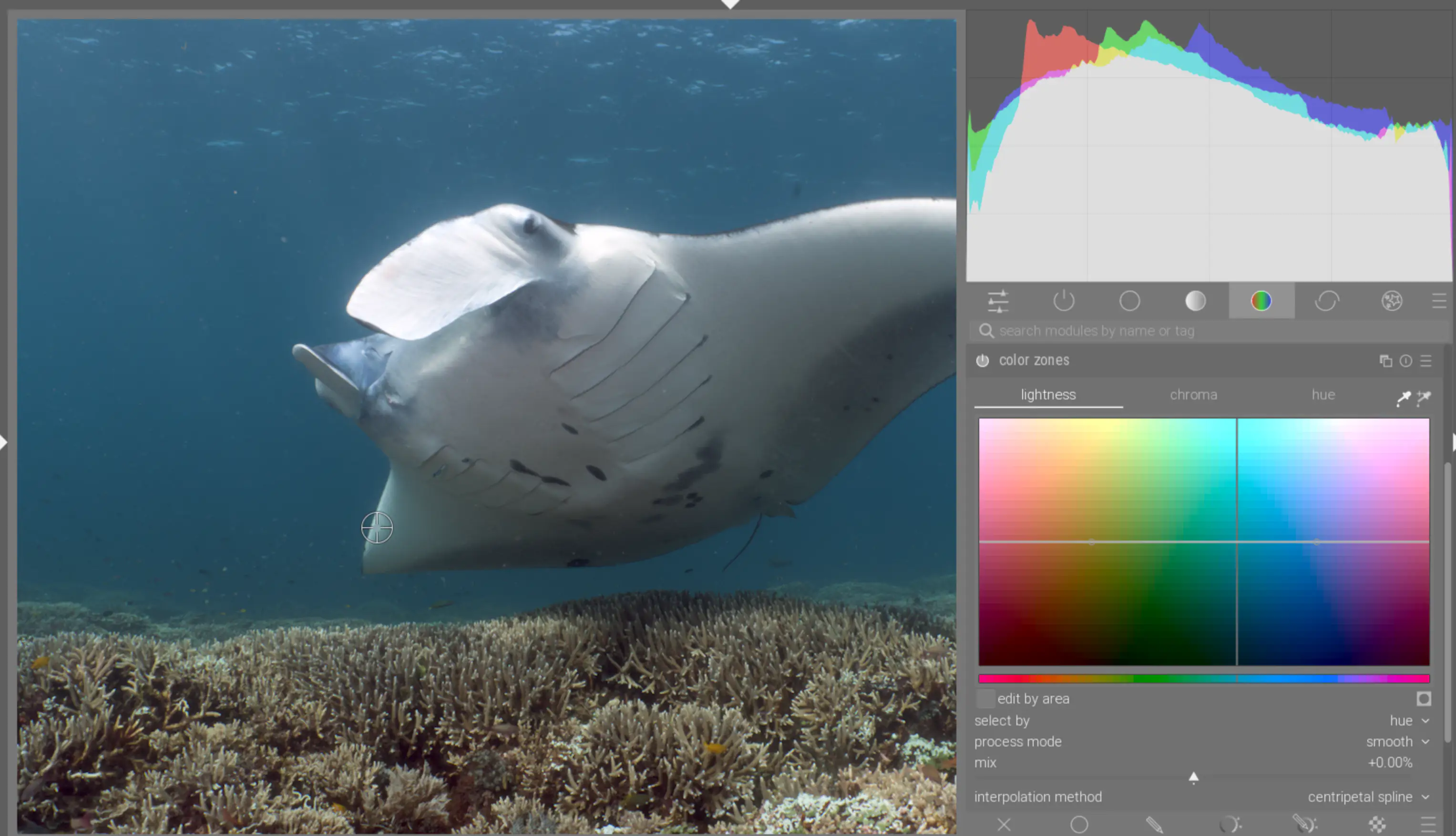
The eye dropper gives me an accurate location on the color spectrum (the vertical line).
Next I will use the three tabs to the following effect:
- Lightness - Bring up the lightness of the aqua’s. This will restore some of the white/grays to a cleaner white.
- Chroma - Slightly reduce the brilliance of the aqua’s, to push them to a more gray tone.
- Hue - Split the aqua’s - the ones closer to green will be greener, and the ones closer to blue will be bluer.
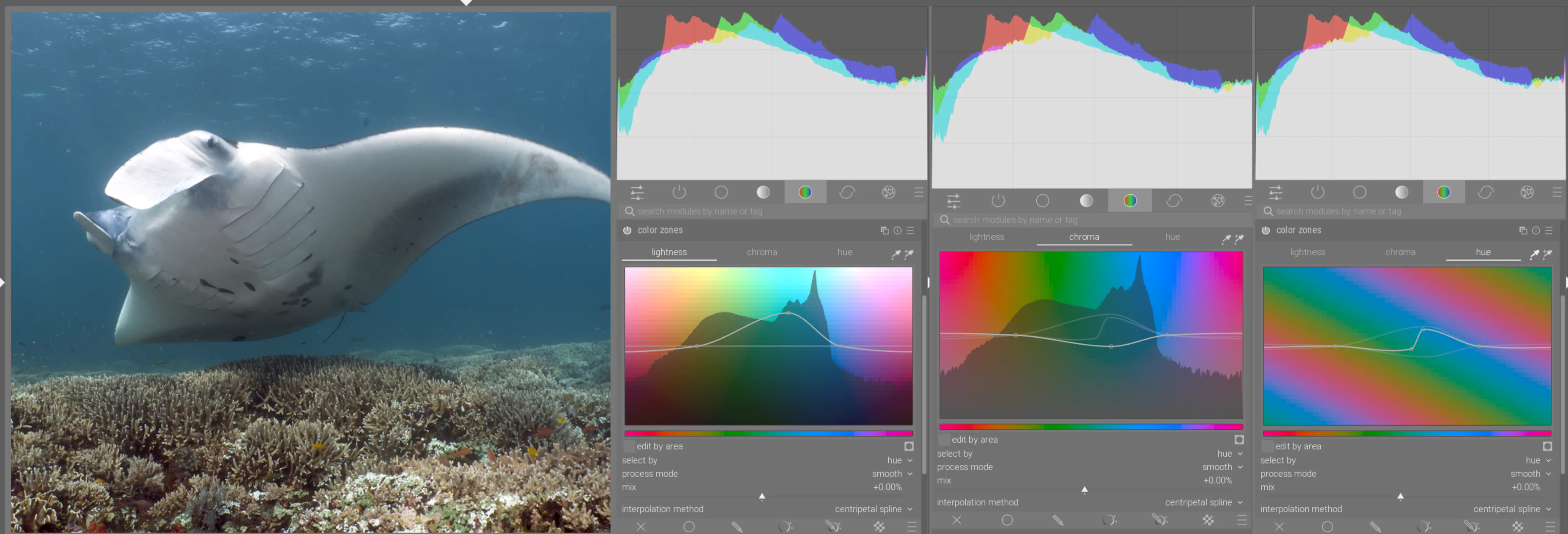
Perhaps I’ll turn this into a GIF later to better show the process.
After this, I apply other filters to reduce haze, bring out more saturation, contrast, etc. Here’s roughly what the edit looked like before passing the image over to GIMP:
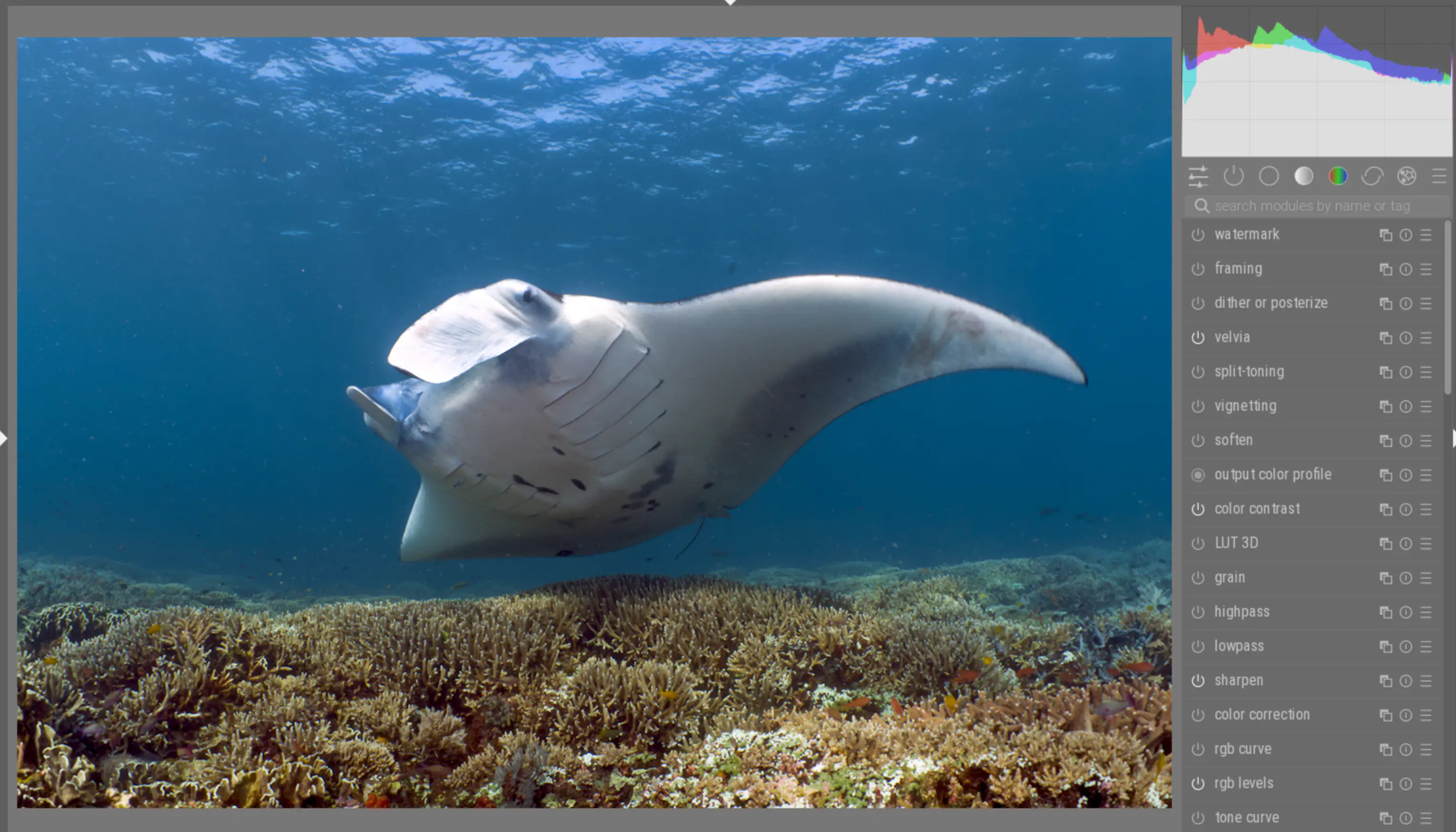
In GIMP, I do more fine tuning, reduce backscatter, and give it final sharpening.
What I learned
I could easily say this photo was also about planning and learning to be patient, waiting for the right moment, etc. But one of the most important things I learned was to put my camera aside. Like many divers, I often find myself trapped in the mindset of “this is a photo dive”, “I have to take as many photos as possible”! When the reality is quite the opposite.
I find that the more photos I take on a dive, the worse the quality of the photos. Thus, we must shift our mindset from “I’m a photographer”, to “I’m on a dive and happen to have my camera for a few special moments”. This allows me to fall back into the role of the observer, letting the world happen around me. This opens my mind to feelings of amazement, majesty, and appreciation for the ocean.
This is why I fell in love with diving in the first place. So what better way to “find” a photograph than to experience the ocean, and then take a photo of that experience.
Conclusion
When we are scuba diving, we are instantly transported into an alien world, full of wonder and mystery. That feeling is what keeps me coming back. I could say the same for lots of daily things we take for granted. Sometimes it’s better to put the “screen” aside, take a breath, and be in the moment.
Diving among manta rays is always spectacular. There is no other way to describe watching these gentle giants swirl and weave above the fragile corals. But they are under threat like many ocean creatures. We must fight to protect our oceans from the suffocating amount of plastic we are producing, the damaging effects of over-fishing, and of course the warming oceans.
I hope you found this write-up informative if nothing else, and I welcome your comments and suggestions in the comments section below. Thank you for reading.